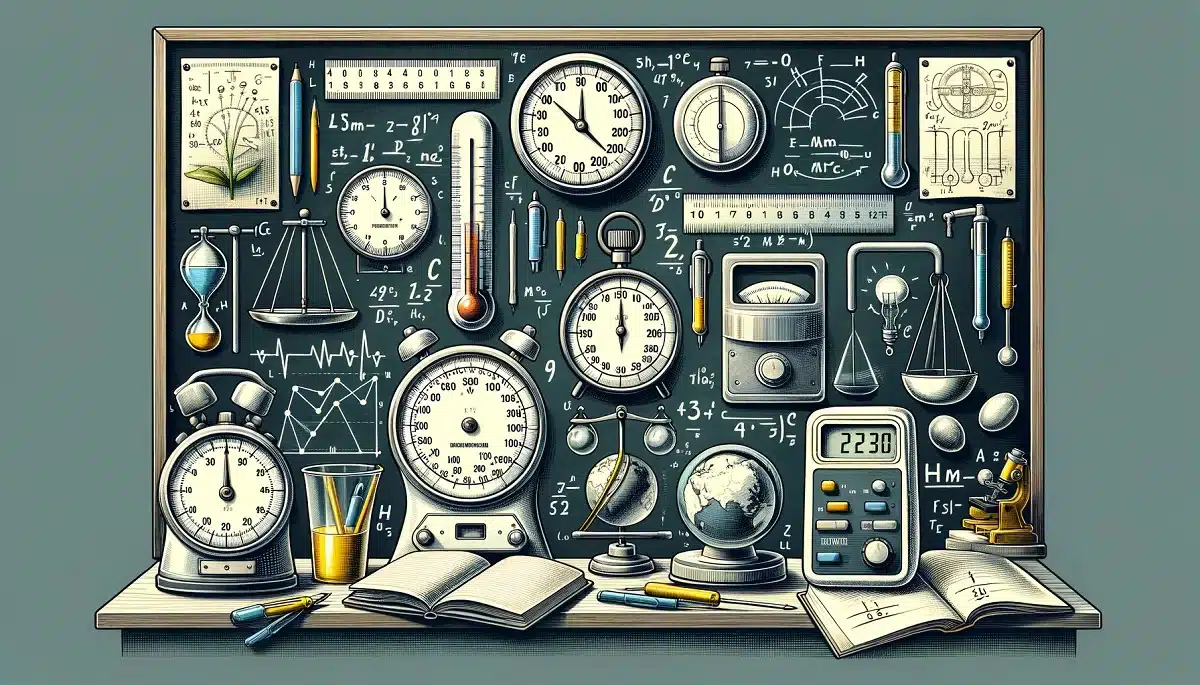
In physics, measurement and units are vital to understanding and expressing quantitatively the fundamental laws of the universe. While measurement allows physical quantities to be expressed in numerical values, units make it possible to compare these measurements with a standard reference.
The International System of Units (SI) includes universally accepted base and derived units to ensure consistency and accuracy in scientific research and daily life. Basic units such as metre, kilogram, second, ampere, kelvin, mole and candela are used to measure length, mass, time, electric current, temperature, amount of matter and light intensity. These standard units ensure that scientific data are universally understandable and comparable, thus underpinning advances in science and technology.
Measurement and Units in Physics
Definition and Importance of Measurement
What is Measurement?
Measurement is the process of expressing a specific quantity of an object or event by comparing it with a standard unit taken as a reference. This process allows physical quantities to be determined numerically. Measurement both forms the basis of scientific research and plays a critical role in technological developments and engineering practices.
The Role of Measurement in Scientific Research
The role of measurement in scientific research is to collect and analyze data with accuracy and precision. Measurement plays an important role in testing hypotheses, designing experiments, and interpreting results. Reliable and repeatable measurement results ensure scientific progress and contribute to the verification of theories.

Definition and Use of Units
What is Unit?
A unit is a standard reference quantity used to express a quantity. Units ensure that measurement results are meaningful and comparable. Units of basic quantities such as length, mass, time, electric current, temperature, amount of matter and light intensity are widely used in physical measurements.
International System of Units (SI)
The International System of Units (SI) is the system in which units of measurement are accepted as a universal standard. SI units are standard units valid worldwide for scientific studies and technical applications. The meter (m), kilogram (kg), second (s), ampere (A), kelvin (K), mole (mole) and candela (cd) are the basic units in the SI system. This system ensures the consistency and accuracy of measurement results.
Fundamental Quantities in Physics
Length
Length Measurement Units
Length measurement units are used to determine the distance of an object from one end to the other. The meter (m) is the most commonly used unit for measuring length. Derivative units such as centimeters (cm), millimeters (mm) and kilometers (km) are also used.
Definition and Usage of Meter
The meter (m) is the base unit of length in the International System of Units (SI). The meter is defined as the distance traveled by light in vacuum in 1/299,792,458 seconds . This definition ensures high accuracy and consistency in measurements. The meter is widely used in engineering, scientific research and daily life.
Mass
Units of Mass Measurement
Units of mass measurement are used to determine the amount of matter in an object. Kilogram (kg) is the basic unit used to measure mass. Derivative units such as gram (g), milligram (mg) and ton (t) also exist.
Definition and Usage of Kilogram
Kilogram (kg) is the basic unit of mass in the SI system. The kilogram is defined in terms of Planck’s constant, which is determined to be 6.62607015 × 10⁻³⁴ joule seconds . The kilogram is widely used in commerce, healthcare, scientific research and engineering applications.
Time
Time Measurement Units
Units of measurement of time are used to determine the duration of events. Second (s) is the basic unit used to measure time. Derivative units such as minutes, hours and days are also commonly used in time measurement.
Definition and Usage of Seconds
Second (s) is the basic unit of time in the SI system. The second is defined as 9,192,631,770 periods of radiation corresponding to the transition of the cesium-133 atom in its ground state between two hyperfine levels . This definition allows for extremely precise and consistent time measurements. Seconds are widely used in scientific research, engineering and daily life.
Electrical current
Electric Current Measurement Units
Electric current measurement units are used to determine the amount of electrical charge flowing in an electrical circuit. Ampere (A) is the basic unit used in measuring electric current.
Definition and Use of Ampere
Ampere (A) is the basic unit of electric current in the SI system. The ampere is defined as the amount of constant current that, if two parallel conductors are one meter apart in vacuum, produces 2 × 10⁻⁷ newtons as a force per meter of length between the conductors . Ampere is widely used in electrical engineering, electronics, and scientific research.

Heat
Temperature Measurement Units
Temperature measurement units are used to determine the degree of thermal energy of an object. Kelvin (K) is the basic unit used in temperature measurement. Derivative units such as Celsius (°C) and Fahrenheit (°F) are also commonly used.
Definition and Use of Kelvin
Kelvin (K) is the basic unit of temperature in the SI system. Kelvin is defined as 1/273.16 of the thermodynamic temperature of water’s triple point (the point where water, ice, and water vapor are in equilibrium) . This definition provides high precision in temperature measurements. Kelvin is widely used in scientific research, especially in the fields of physics and chemistry.
Amount of Substance
Substance Quantity Measurement Units
Quantity units of matter are used to determine the number of atoms or molecules in a system. Mole (mole) is the basic unit used to measure the amount of substance.
Definition and Use of Mole
Mole (mole) is the unit of amount of basic substance in the SI system. One mole contains 6.02214076 × 10²³ (Avogadro’s number) of atoms, molecules, or ions . This definition provides precision in the calculation and analysis of chemical reactions. Mole is used in many scientific research fields, especially chemistry and biology.
Light Intensity
Light Intensity Measurement Units
Luminous intensity measurement units are used to determine the amount of light emitted by a light source. Candela (cd) is the basic unit used to measure light intensity.
Definition and Use of Candela
Candela (cd) is the basic unit of luminous intensity in the SI system. The candela is defined as light propagating in a given direction having a luminous flux of 1/683 watt per second in that direction when emitting monochromatic light of frequency 540 × 10¹² hertz . This definition provides consistency in measuring the brightness of light sources. Candela is widely used in lighting engineering, photography, and other light-related scientific fields.
Derived Quantities in Physics
Speed and Acceleration
Speed Measurement Units
Velocity measurement units are used to determine the distance traveled by an object in a given time interval. Meter per second (m/s) is the SI unit of speed. Derivative units such as kilometers per hour (km/h) and miles per hour (mph) are also commonly used.
Acceleration Measurement Units
Acceleration measurement units are used to determine the amount by which an object’s velocity changes over a given time interval. Meter per second² (m/s²) is the SI unit of acceleration. Acceleration refers to the rate at which a moving object accelerates or decelerates.
Force and Pressure
Force Measurement Units
Force measurement units are used to determine the amount of push or pull applied to the mass of an object. Newton (N) is the SI unit of force. Newton is defined as the amount of force that gives an acceleration of 1 meter/second² to a mass of 1 kilogram.
Pressure Measurement Units
Pressure measurement units are used to determine the amount of force applied to a surface per unit area of this surface. Pascal (Pa) is the SI unit of pressure. Pascal is defined as 1 Newton of force applied perpendicularly to a surface of 1 square meter. Derivative units such as bar, atmosphere (atm) and millimeters of mercury (mmHg) are also used.
Energy and Power
Energy Measurement Units
Energy measurement units are used to determine the capacity of a system to do work. Joule (J) is the SI unit of energy. Joule is defined as the work done by 1 Newton of force at a distance of 1 meter. In addition, derivative units such as kilowatt-hour (kWh) and calories (cal) are also used in energy measurement.
Power Measurement Units
Power measurement units are used to determine the amount of work done or energy transferred per unit time. Watt (W) is the SI unit of power. Watt is defined as the transfer of 1 joule of energy in 1 second. Derivative units such as kilowatts (kW) and horsepower (HP) are also used to measure power.
Electrical Quantities
Resistance, Voltage and Capacitance Measurement Units
Units of measurement of resistance, voltage, and capacitance are used to determine the basic characteristics of electrical circuits. Ohm (Ω) is the SI unit of resistance. Volt (V) is the SI unit of voltage and Farad (F) is the SI unit of capacitance. Resistance is the amount of resistance to the passage of electric current in a circuit; voltage, electrical potential difference; Capacitance refers to the capacity of a capacitor to store electrical charge.
Electrical Power and Energy Measurement Units
Electrical power and energy measurement units are used to determine work capacity and energy consumption in electrical circuits. Watt (W) is the SI unit of electrical power. Kilowatt-hour (kWh) is a common unit of measurement of electrical energy and expresses the energy consumption of electrical devices. Joule (J) is also a unit used to measure electrical energy.